

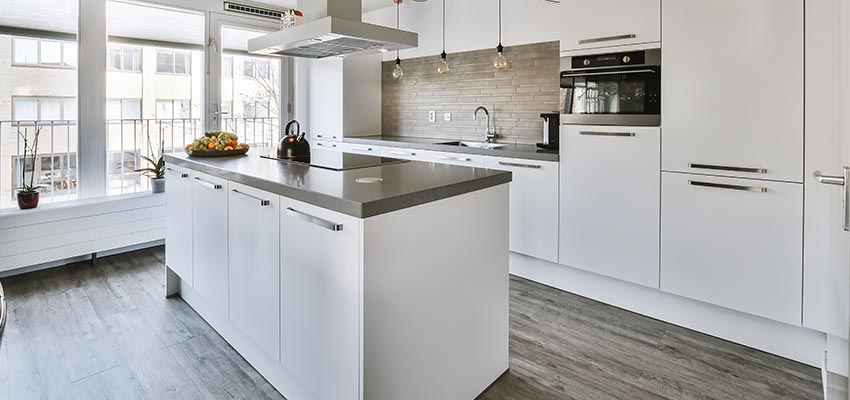
When it comes to high-quality cabinets for kitchens, bathrooms, and laundry rooms, solid wood and plywood are the preferred materials. But which one is better? How to choose between solid wood and plywood when buying ProCraft cabinets? Here’s a comparison.
Comparing Solid Wood And Plywood Cabinets
Before comparing solid wood and plywood cabinets, one thing should be cleared. Solid wood is rarely used for the cabinet box (carcass) because it’s impractical due to the higher cost and a few stability problems. So, plywood is the gold standard when it comes to high-quality cabinet boxes. However, there are other lower-cost materials used for cabinet boxes as well, such as HDF and MDF.
Here, we are comparing these two materials so you can decide which one is better for the cabinet face frame, doors, and drawer boxes. It’s an important decision because the choice will not only impact the appearance but also the durability, moisture resistance, and cost of the project.
Composition
Solid Wood Cabinets
Solid wood is sourced directly from timber and cut into required pieces for cabinet face frames, doors, and drawers. Various types of tree species are used for cabinets, so you have a lot of variety when it comes to durability, appearance, and cost of your cabinets. In any case, solid wood cabinets offer a high-end, timeless appearance that no engineered material can replicate.
Plywood Cabinets
Plywood is made of gluing and pressing thin layers of wood arranged in a cross-grain pattern for panels that are durable and moisture-resistant. This makes it the most favorable cabinet box material when high strength and durability is the goal. It’s also an attractive material for cabinet face frames, doors, and drawers.
Appearance And Finishes
Solid Wood Cabinets
That’s easy! Solid wood cabinets offer an unmatched and classic appearance that’s hard to beat. Natural wood is unique so no two panels will look exactly alike, adding depth and authenticity to the space. Moreover, each tree species has its own grain pattern, making its appearance unique.
There are many types of finish options for solid wood cabinets, some popular ones are listed here:
- If you need a clear finish that highlights the natural wood without any “shade”, you can use clear polyurethane, lacquer, varnish, or oil finishes.
- If you like stained finishes that add a bit of color, you can go with options like oil or water-based stains for solid wood. Gel stains are also popular for a uniform appearance.
- For opaque color finishes that completely hide the wood under it, your options are acrylic, lacquer, milk, or spray paint.
Not only that, you can even use a combination of these finishes for the desired appearance. If the finish doesn’t offer sealing capabilities, such as oil, you will need to use a top coat of clear polyurethane, lacquer, or varnish to seal the cabinets.
Plywood Cabinets
Plywood cabinets always have finishes that elevate their look. You can use most of the finishes mentioned above. The prime difference probably is the use of veneers or overlays.
A veneer is a thin layer of laminate, solid wood, or thermofoil that completely changes the appearance of plywood and makes it look like something else, for instance, solid wood. You can then apply a finish on top of that veneer.
Durability And Moisture Resistance
Solid Wood Cabinets
Solid wood cabinets are highly durable because they are wood panels through and through. If you maintain, stain, and seal them regularly, they can last for decades. However, that’s not it, unfortunately.
Solid wood is naturally prone to moisture and it can expand in humid conditions and contract in dry conditions, causing damage such as rotting, warping, cracking, and splitting. The cabinetry may change shape, leading to functional problems like the cabinet doors not opening and closing smoothly or the cabinets looking weird and crooked. This is why solid wood cabinets are not recommended for moist areas, like bathrooms and laundry rooms.
This is also why solid wood is rarely used for cabinet boxes. However, they are preferred for cabinet doors, drawer fronts, and trims in high-end cabinets.
Plywood Cabinets
One of the reasons why plywood exists is that there was a need for a material that should have the durability of wood, but doesn’t have its downsides. High-quality plywood is that material. It’s highly durable and it’s not as vulnerable to moisture as solid wood, making plywood cabinets a great option for kitchens, bathrooms, laundry rooms, and any other room.
But fair maintenance is still required. With it, plywood cabinets can last for 15 to 25+ years.
Maintenance
Solid Wood Cabinets
Wood is naturally porous, so it needs to be sealed and waxed once a year, and preferably every 6 months, to make sure the surface remains waterproof and the effects of moisture and humidity are not too harsh on the cabinets.
Apart from that, you need to use a damp cloth and a mild soap for cleaning the wood cabinets. Avoid harsh chemicals because they will do more bad than good.
Plywood Cabinets
Plywood also requires sealing, but not as often as wood, so it’s low maintenance compared to solid wood. If you’re applying wood veneer, then you will need to seal it just like you would seal hardwood. Make sure to take care of the edges because they are usually more vulnerable.
Other than that, plywood cabinets can also be cleaned with a damp cloth and a mild soap. Harsh cleaners are not suggested for plywood as well.
Repairability
Solid Wood Cabinets
Even though solid wood is not a star when it comes to moisture resistance, it is when it comes to repairability. Solid wood can be sanded, refinished, and repaired multiple times in its lifetime. If there are scratches and dents, you can sand, fill, or refinish them. Even cracks and splits can be glued or clamped.
So, even though it’s susceptible to damage, it can be repaired more easily. However, this does make it high maintenance.
Plywood Cabinets
Plywood cabinets are generally more durable and require repairs less frequently. But when they do, it’s difficult to deal with them. Sanding and refinishing are not as easy because it’s limited by the thickness of the veneer glued on top of the plywood.
In addition to that, if plywood is damaged due to moisture, it delaminates, even though it’s not that common. Delaminated plywood is also difficult to repair, however, you can try reglueing it.
Cost
Solid Wood Cabinets
Wood cabinets have variable costs due to the different types of tree species used. However, even the cheaper wood would cost more than plywood. And then there are more expensive options like cherry, maple, and red oak, that cost even more.
Plywood Cabinets
Plywood cabinets are generally priced lower than solid wood. According to rough estimates, plywood cabinets may be 20% to 50% cheaper than solid wood cabinets.
Conclusion
Both solid wood and plywood cabinets are considered high-quality options, but plywood is more durable and moisture-resistant. Plus, it also costs less than solid wood. Therefore, if you want a lower cost but a highly durable option, choose all-plywood cabinets.
If you fancy the appearance of solid wood, then use plywood cabinet boxes with solid wood cabinet doors and face frames. However, remember that solid wood cabinets are not recommended for moisture-prone areas, like bathrooms and laundry rooms. Consult a ProCraft cabinetry dealer MD for suggestions, samples, and installation.